The Body as Mirror of Consciousness
Consciousness always leaves traces — thought becomes physiology, belief becomes posture, fear becomes breath — and the body reveals what consciousness has practiced and what it has hidden.
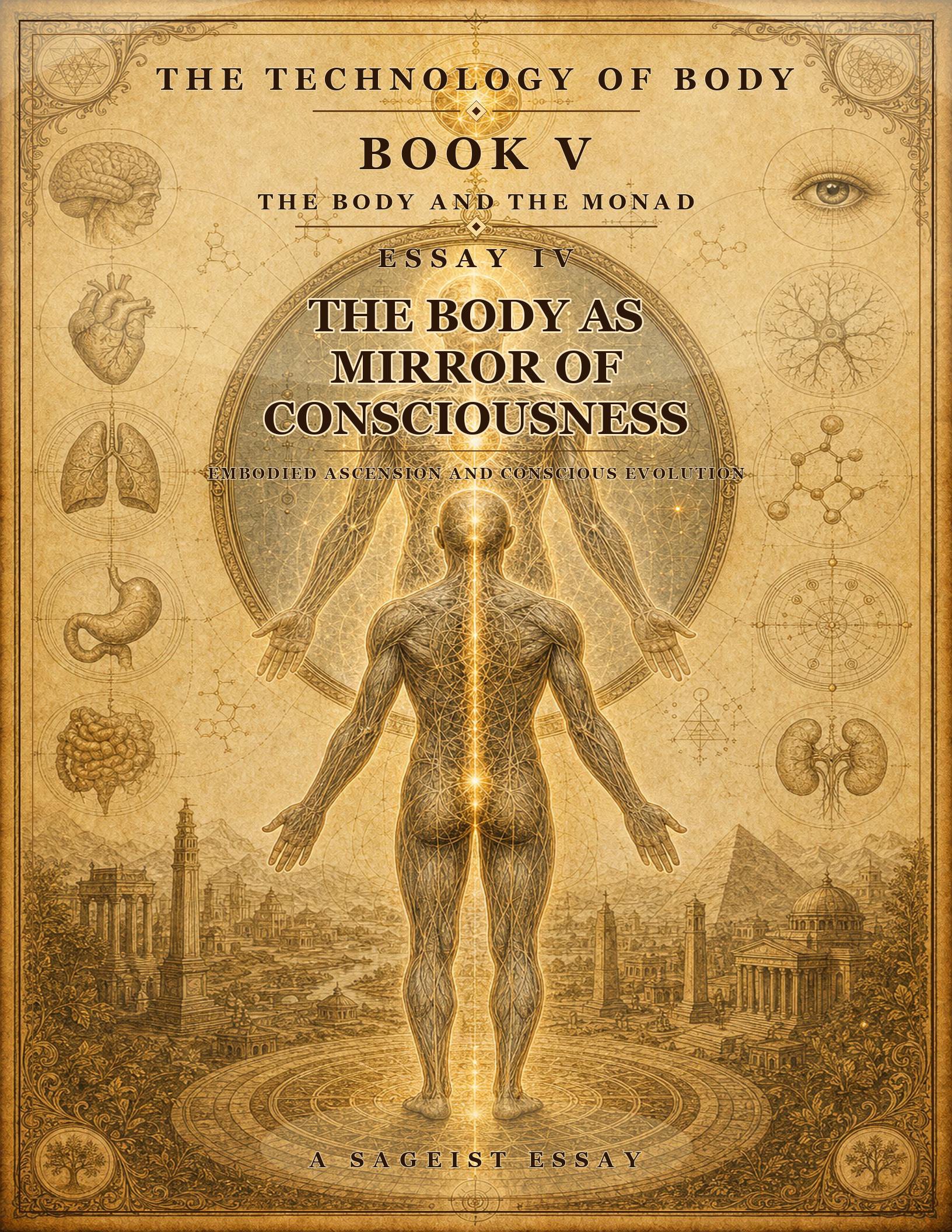
Consciousness always leaves traces. Nothing inward remains entirely without form. Thought affects physiology. Emotion alters chemistry. Belief changes posture. Fear changes breathing. Grief weakens energy. Hope changes movement. Devotion changes the eyes. Shame bends the spine. Courage gathers the chest. The body continuously reflects inner reality.
The body mirrors consciousness. This does not mean the body is a simple screen upon which thought projects whatever it wants. Biology has its own laws. Chemistry has its own intelligence. Inheritance, environment, illness, fatigue, food, injury, sleep, and circumstance all matter. Yet consciousness moves through these conditions and leaves signatures. The invisible becomes visible through pattern.
A person may hide an opinion, but the body often reveals the state beneath the opinion. The jaw tightens. The breath shortens. The shoulders rise. The eyes turn away. The stomach contracts. The voice hardens. Long before language confesses the truth, the organism begins to speak. The body cannot lie for long.
This principle explains why transformation cannot remain intellectual. A person may change beliefs without changing embodiment. They may adopt new ideas while the nervous system remains organized around old fear. They may speak of forgiveness while the body still guards against contact. They may praise freedom while posture continues to carry captivity. Thought can move faster than the body, but transformation requires the body to follow.
True transformation reorganizes physiology itself. Breath becomes less defensive. Muscles release unnecessary vigilance. The spine learns a new dignity. The face becomes less armored. The voice becomes more honest. Attention becomes less scattered. The heart becomes less hidden. The body begins to express the new order of consciousness.
This is why the doctrine never treats the body as secondary. The body reveals whether consciousness has become embodied or merely admired. Ideas are easy to decorate. Embodiment is harder to falsify. A philosophy that has not reached the body remains a theory. A prayer that has not altered conduct remains a sound. A vow that has not entered posture, habit, speech, appetite, and attention remains unfinished.
The initiate learns to observe the mirror carefully. Observation begins without accusation. The body should not be treated as an enemy, a failure, or a shameful witness. It should be approached as a faithful reflector. If the body contracts, something is being protected. If the body collapses, something may be exhausted. If the body inflames, something may be overloaded. If the body numbs, something may have become too much to feel.
Physical existence becomes diagnostic, but not simplistic. The Sageist refuses crude interpretation. A symptom is not automatically a spiritual message. Pain is real. Disease is real. Material conditions are real. Yet the body also communicates through these realities. Wisdom listens without superstition and treats without reduction.
A fearful consciousness contracts the body. The organism prepares for danger by narrowing perception, shortening breath, tightening muscle, increasing vigilance, and moving energy toward survival. This contraction may be necessary in moments of threat. But when fear becomes chronic, contraction becomes identity. The body begins to inhabit the world as if danger were the first truth.
A coherent consciousness expands the body. Not in theatrical display, but in ease, breath, orientation, and availability. The chest has room. The spine has life. The eyes can receive. The hands can open. Movement becomes less defensive. The person does not need to occupy more space through domination because presence itself becomes sufficient.
An exhausted consciousness reveals itself through posture. The body bends beneath invisible burdens. The neck carries unspoken pressure. The shoulders become shelves for responsibility. The face loses brightness. Movement becomes economical, guarded, or heavy. Exhaustion is not merely tiredness. It can become a worldview when the organism no longer expects restoration.
A fragmented consciousness reveals itself through behavior. Attention jumps. Speech contradicts action. Desire pulls in one direction while fear pulls in another. The body begins to live as a parliament without a sovereign center. Habit, appetite, wound, ambition, and anxiety compete for command. The visible life becomes the outer image of inner disorder.
The body exposes the invisible. It translates hidden conditions into tone, rhythm, impulse, temperature, tension, and expression. It tells the truth in a language older than speech. This is why the body has always been central to initiation. The initiate cannot simply claim an inner state. The initiate must become it.
Book I revealed the body as original technology. Book II revealed the nervous system as consciousness interface. Book III revealed symbolic physiology. Book IV revealed initiation through embodied practice. Book V now reveals the Monad as the center dwelling within embodiment. Essay IV asks how the body reflects the condition of this indwelling consciousness.
The mirror is not always comfortable. Many people prefer an idea of themselves to the evidence of their body. They imagine themselves calm while living in constant activation. They imagine themselves generous while the hands remain closed. They imagine themselves free while appetite governs them. They imagine themselves forgiving while the body still rehearses resentment.
The body brings the person back to truth. It does not flatter the ego. It reveals what has been practiced. If the body is trained by fear, it reflects fear. If trained by resentment, it reflects resentment. If trained by discipline, it reflects discipline. If trained by beauty, it reflects beauty. If trained by presence, it reflects presence.
This relationship also explains suffering. The body often expresses what consciousness refuses to acknowledge. Ignored emotions accumulate. Chronic tension develops. Stress becomes chemistry. Conflict becomes inflammation. Suppression becomes fatigue. The organism bears witness to what the personality will not admit.
Suppression is not disappearance. What is denied does not vanish. It descends into the body as pressure, contraction, vigilance, numbness, compulsion, or symptom. The mind may say, I am fine. The breath says otherwise. The voice says otherwise. Sleep says otherwise. The stomach says otherwise. The body becomes the archive of the unspoken.
This does not mean every illness is caused by repression. Such thinking becomes cruel when applied without humility. The body is complex. Genetics, environment, pathogens, injury, nutrition, aging, toxins, social conditions, and medical realities must be honored. But the doctrine also recognizes that consciousness participates in the body's atmosphere. Inner conflict has biology.
Stress becomes chemistry because the body must turn experience into function. It cannot simply observe fear. It must mobilize. It cannot simply contemplate threat. It must prepare. It cannot simply endure grief without consequence. It must reorganize energy. The body translates meaning into biology because incarnation requires the invisible to become operational.
The same is true of hope. Hope changes movement. It does not merely decorate thought. When genuine hope enters the organism, the future becomes imaginable. Breath has more room. The face lifts. Endurance increases. Action becomes possible. Hope is not fantasy when grounded in discipline. It is a biological reorientation toward possibility.
Belief changes posture because belief tells the body what reality is. A person who believes they have no right to exist may shrink even in safe rooms. A person who believes they must prove themselves constantly may lean forward into chronic pressure. A person who believes they are always threatened may scan the environment with restless eyes. A person who remembers dignity may stand differently.
The body is therefore a philosophical document. It reveals metaphysics through stance. It shows whether the person lives as prey, performer, ruler, servant, orphan, exile, guardian, lover, initiate, or witness. These identities are not only mental. They become muscular. They become respiratory. They become chemical. They become visible.
To study posture is to study worldview. A collapsed body may hold grief, defeat, shame, or exhaustion. A rigid body may hold control, pride, fear, or defense. A scattered body may hold anxiety or fragmentation. A graceful body may hold practice, coherence, confidence, or surrender. The body does not give simplistic answers, but it asks precise questions.
Breath is one of the clearest mirrors. Breath shows the relationship between consciousness and safety. When fear governs, breath often rises and shortens. When grief overwhelms, breath may become shallow or irregular. When anger activates, breath may harden. When trust appears, breath deepens. When attention gathers, breath becomes rhythmic. Breath reveals the state of the inner kingdom.
Voice is another mirror. The voice carries the architecture of consciousness into sound. It reveals pressure, sincerity, hesitation, arrogance, tenderness, authority, fear, or presence. Words can be chosen, but tone often escapes control. The body speaks through the voice before the ego edits the sentence.
The eyes mirror consciousness through attention. They can consume, avoid, judge, soften, receive, command, or disappear. An integrated gaze does not invade and does not flee. It meets. It reveals a person capable of contact without domination. The eyes are not merely organs of sight. They are thresholds of presence.
The hands mirror consciousness through relation. Closed hands protect. Grasping hands possess. Restless hands discharge. Gentle hands bless. Disciplined hands build. Violent hands reveal disorder. Skilled hands reveal memory. The hands show how inner reality approaches the world: to take, to defend, to craft, to heal, to offer, or to control.
The body also mirrors attention. A person scattered by constant stimulation may move with a subtle disorganization. Their gestures begin before completing. Their breath follows interruption. Their eyes seek novelty. Their nervous system expects the next signal. The body learns the tempo of the civilization it inhabits.
Modern technology exploits the mirror by training the body into fragmented states. Alerts, feeds, metrics, images, comparisons, and outrage loops shape physiology. Attention becomes restless, breath shortens, posture collapses, sleep is disturbed, desire is inflamed, and stillness becomes uncomfortable. The body reflects the digital field.
This has civilizational implications. If millions of bodies are trained into fragmentation, civilization will mirror fragmentation. Institutions will become reactive. Politics will become nervous. Markets will feed compulsion. Media will amplify fear. Schools will struggle to cultivate attention. Families will inherit the overstimulation of the age.
The body is not the only mirror of consciousness. Civilization is also a mirror. Architecture reflects values. Economics reflects appetite. Technology reflects ambition. Law reflects fear and trust. Education reflects what a culture believes a human being is. Media reflects the nervous system of the collective. What lives within people eventually becomes structure around them.
This is the Sageist axiom: civilization mirrors consciousness. The body is the first mirror, and civilization is the enlarged mirror. What an individual cannot regulate inwardly often appears as disorder in relationships. What a culture cannot integrate inwardly appears as disorder in institutions. The outer world becomes the public body of the inner condition.
To transform civilization, the mirror must be read at multiple levels. The individual body reveals personal patterns. The family system reveals relational memory. The institution reveals collective habits. The city reveals social values. The technological environment reveals what a civilization worships. The planet reveals the consequences of human consciousness acting through systems.
The initiate begins close. Before redesigning the world, the Sageist learns to read breath, posture, appetite, speech, sleep, movement, and attention. This is not narcissism. It is apprenticeship. The person who cannot read the body's mirror will often misread the world. Inner blindness becomes outer strategy.
Observation must be paired with compassion. If the body reveals fear, the answer is not hatred of fear. If the body reveals grief, the answer is not shame. If the body reveals collapse, the answer is not contempt. The body reveals what needs relationship. A mirror does not condemn the face. It shows what is there.
The first practice is witnessing. The person notices the body without immediate correction. Where is the breath? Where is the tension? What is the posture saying? What does the voice conceal? What does the stomach know? What does fatigue reveal? What does the body do when truth is spoken? What does it do when a boundary is crossed?
The second practice is interpretation. The person asks what pattern may be reflected. Is this protection? Is this grief? Is this anger? Is this habit? Is this inherited? Is this environmental? Is this medical? Is this symbolic? Interpretation must remain humble because the body speaks in layered language. One symptom may carry many meanings.
The third practice is reorganization. The person uses breath, movement, rest, truth-telling, boundary, nourishment, therapy, ritual, medical care, silence, and discipline to alter the underlying pattern. Transformation becomes practical. The mirror is not read for curiosity alone. It is read so consciousness can become more ordered.
The body as mirror also changes spiritual practice. Spirituality cannot be measured only by visions, beliefs, or language. Does practice make the person more embodied? More honest? More regulated? More compassionate? More courageous? More responsible? More capable of love? More able to tell the truth without violence? The body reveals the answer.
The Monad sees itself through the body because the body reflects the state of incarnation. The Monad is not reducible to the body, but it cannot ignore what the body reveals. If consciousness enters form, form becomes a teacher. The body shows where the Monad's light is clear, where it is distorted, where it is blocked, and where it has not yet descended.
There are places in the body where consciousness has not fully entered. A person may be present in the mind but absent from the heart. Present in desire but absent from responsibility. Present in speech but absent from sensation. Present in ambition but absent from grief. The mirror reveals these absences through numbness, tension, compulsion, and contradiction.
Healing is the return of consciousness to exiled territory. The body becomes more whole as awareness descends into what was abandoned. A guarded chest may soften. A frozen throat may speak. A clenched abdomen may release. A collapsed spine may rise. A restless nervous system may find rhythm. These are not merely physical changes. They are consciousness returning to form.
The mirror also reveals beauty. The body does not only show wounds. It shows virtues. Patience has a rhythm. Integrity has a tone. Devotion has a posture. Courage has a breath. Wisdom has a gaze. Love has a temperature. Discipline has a shape. Presence has gravity. The body can reveal the invisible virtues that have become embodied.
The solar human is recognized through this mirror. Such a person may not appear perfect, glamorous, or invulnerable. Their body may age, ache, tire, and suffer like any other body. Yet something coherent moves through them. Their presence is not performance. Their body reflects a center. They transmit order because they have become ordered.
This is not achieved by image culture. Image culture trains the body to be viewed from outside. Sageism trains the body to be inhabited from within. Image culture asks how the body appears. The doctrine asks what the body reveals. Image culture worships surface. Initiation reads depth. The mirror of consciousness is not vanity. It is truth.
The modern body is often trapped between neglect and obsession. It is ignored as intelligence, then idolized as appearance. It is overworked, then decorated. It is stimulated, then medicated. It is judged, then exploited. The Sageist path restores the body as a sacred mirror: not commodity, not idol, not machine, but living revelation.
This restoration requires daily honesty. How does my body respond to the life I am living? What does my fatigue know? What does my breath know? What does my posture say about my relationship to power? What does my appetite say about longing? What does my tension say about boundaries? What does my movement say about hope?
Such questions are not meant to make the person self-absorbed. They are meant to restore responsibility. A person who reads the mirror can make better choices. They can change environments, repair relationships, seek help, speak truth, rest, train, grieve, build, and practice. The body reveals where the next work begins.
The mirror must also be read collectively. What do the bodies of a society reveal? Exhaustion. Speed. Numbness. Anxiety. Inflammation. Addiction. Loneliness. Overstimulation. Dissociation. These are not merely private failures. They are messages from civilization's body. A culture cannot constantly dysregulate its people and then blame them for becoming dysregulated.
A regenerative civilization must become a better mirror. It must design spaces that help the body remember dignity. It must create rhythms that permit restoration. It must produce food that supports clarity. It must use technology in service of attention. It must educate the young in embodiment, emotional regulation, beauty, discipline, and truth. Civilization must stop training the body into fragmentation.
The body as mirror also reveals the ethics of leadership. A leader's state enters the room before their policy. Anxiety spreads. Vanity spreads. Rage spreads. Presence spreads. Coherence spreads. The body of the leader becomes part of the nervous system of the group. True leadership begins with self-governance because the ungoverned self becomes collective weather.
The same law governs intimate life. Partners regulate one another. Parents install memory in children. Friends can awaken or dull each other. Communities create shared posture. The body mirrors not only personal consciousness, but relational consciousness. We become, in part, what we repeatedly inhabit together.
The path of the initiate is therefore not private perfection. It is relational clarity. As the body becomes more coherent, it becomes safer for others. As breath deepens, the room changes. As speech becomes honest, trust becomes possible. As posture becomes dignified, others remember dignity. Presence is transmission because the body mirrors and influences the field.
The doctrine reaches a simple but demanding conclusion: the invisible must become accountable to the visible. If consciousness is real, it must eventually appear as conduct. If wisdom is real, it must alter the body. If love is real, it must change touch, speech, rhythm, and responsibility. If the Monad is awake, the body will gradually reflect that awakening.
Essay IV closes with this recognition: the body is the mirror through which the Monad sees itself clearly. It reveals the traces of thought, emotion, belief, fear, grief, hope, discipline, and love. It shows what consciousness has practiced and what consciousness has hidden. The body does not condemn. It reflects.
The gate closes here: to know the body deeply is to understand consciousness indirectly. The body eventually reveals everything consciousness attempts to conceal, and it also reveals every virtue consciousness has made real. The initiate learns to read the mirror, not to worship the reflection, but to refine the one who stands before it.